Edge Hosting & Edge Computing

Infrastructure Editor
Disclosure: Some links on this page are affiliate links — if you sign up through one, we may earn a commission at no extra cost to you. It never changes our ratings, rankings or verdicts: we don't sell hosting and take no pay-for-placement.
Who it's for
- Global audiences
- Latency-sensitive apps
- Jamstack and static-site owners
- API developers
Edge hosting distributes app code and cached content across a network of points-of-presence (PoPs) placed physically close to end users, rather than serving everything from one or a handful of centralized data centers. Among the types of web hosting, it’s the one built specifically around latency as the primary performance metric.
What Edge Hosting Is
Edge hosting, sometimes called edge computing when referring to the broader pattern, runs code or serves content from servers positioned at the “edge” of the network. These are geographically distributed locations near where users actually are, rather than a single origin server that every request has to reach regardless of where the user is located. It’s the same underlying principle as a content delivery network (CDN), extended from just caching static files to also running application logic.
How Edge Hosting Works
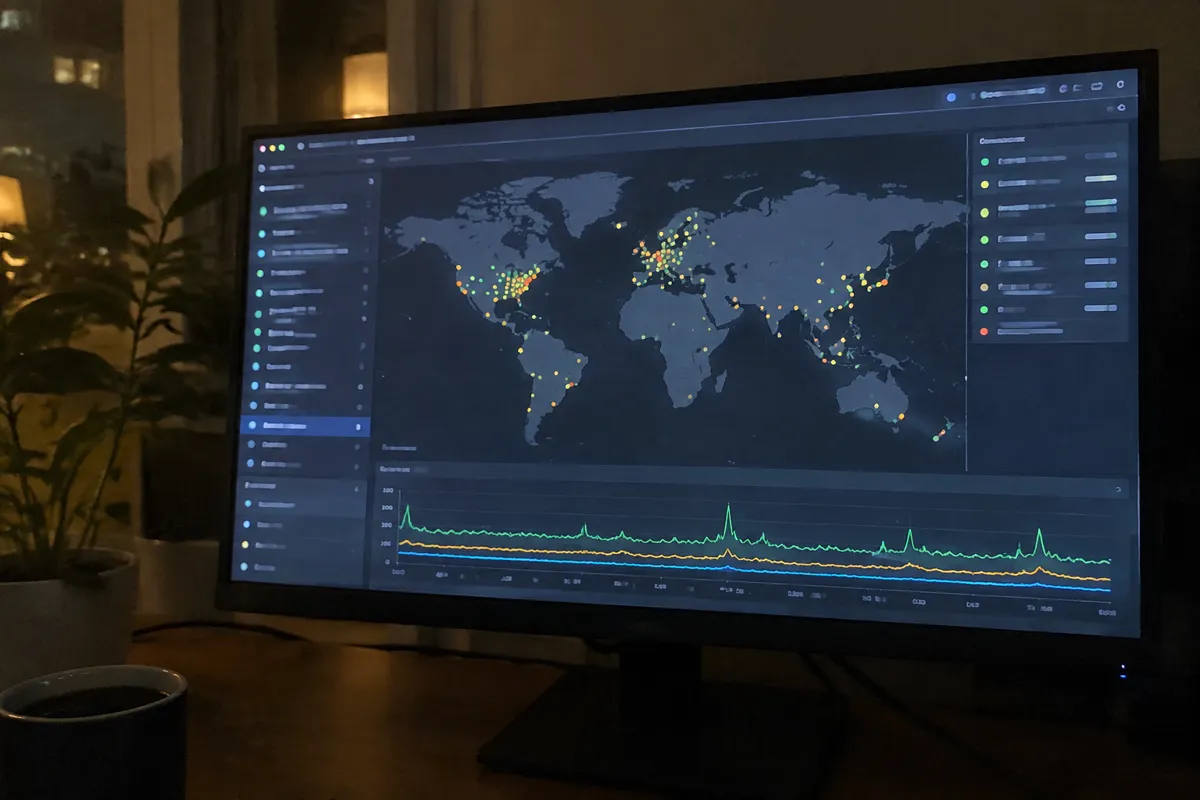
A provider maintains a global network of PoPs, each capable of serving cached content or executing lightweight application code. When a request comes in, the platform’s routing layer directs it to the nearest PoP rather than a single centralized origin. For static content, this means the response comes from a server physically close to the user, cutting the network round-trip time significantly. For dynamic edge functions, small pieces of application logic — often written to run in a constrained, sandboxed runtime — execute at that same nearby location instead of needing a round trip to a distant central server. See server location & data centers for how physical proximity translates directly into response-time improvements.
Edge Hosting Resource Isolation
Isolation on edge platforms is typically per-function or per-request, particularly on serverless-style edge computing offerings. Each incoming request or function invocation runs in its own isolated execution context, spun up and torn down quickly, rather than persisting as a long-running server process the way a VPS or dedicated server does. Resource allocation per request is intentionally small and tightly bounded, since the whole model depends on being able to run many lightweight executions across a huge number of distributed locations simultaneously.
Edge Hosting Price and Usage-Based Billing
Edge hosting is billed on a usage basis, most often per request served or per unit of compute time consumed, echoing cloud hosting’s pricing model rather than a flat monthly rate. Many providers offer a generous free tier for low-volume use, with costs scaling as request volume and compute time increase. There’s no single fixed price band the way there is for shared or dedicated hosting. The number depends entirely on traffic volume and how much logic runs at the edge versus at a central origin.
Edge Hosting Performance Ceiling and Latency
The performance ceiling for edge hosting is defined less by raw compute power and much more by latency — the time it takes a request to reach a server and get a response back. Because the serving location is close to the user, time-to-first-byte drops substantially for a globally distributed audience, compared to every request traveling to one central location. Edge hosting is not designed for heavy, sustained compute workloads. Its strength is fast, lightweight responses distributed everywhere at once, not maximum throughput on any single request.
Who Edge Hosting Suits
Edge hosting suits latency-sensitive applications where shaving milliseconds off response time meaningfully affects user experience or conversion. It suits static sites and Jamstack hosting builds with a genuinely global audience, since static assets are a natural fit for edge distribution. It also suits API endpoints that need consistently fast response times worldwide, rather than fast responses only for users near one central data center.
Edge Hosting Limitations
The restricted runtime is the defining limitation. Many edge platforms deliberately don’t support long-running processes, large memory allocations, or heavy server-side computation. The execution model is built for short, fast, stateless functions, not full application servers. That rules out edge hosting as a standalone solution for compute-heavy workloads: database-heavy processing, large file transformations, or anything that needs to maintain state across a long-running connection typically still needs a centralized server or a hybrid architecture.
Edge Hosting Upgrade Path
Edge hosting typically isn’t “upgraded” the way a fixed-resource type is scaled up. Instead, workloads that outgrow the edge runtime’s constraints move logic back to a centralized origin, often cloud hosting, while keeping the edge layer for what it’s genuinely good at: caching, routing, and lightweight request handling in front of that origin. A common architecture uses edge hosting as the outer layer and cloud or VPS infrastructure as the origin behind it, rather than treating the two as a strict either/or choice. See hosting CDN for the closely related caching layer that most edge platforms build on top of.

FAQ
Is edge hosting the same as a CDN? They’re closely related but not identical. A traditional CDN mainly caches and serves static content from distributed locations. Edge hosting extends that model to also run application logic — dynamic code — at those same distributed points, not just static file delivery.
Does edge hosting replace the need for a central server? Usually not entirely. Most edge architectures still rely on a central origin server for data storage, heavier processing, or anything the edge runtime’s constraints can’t handle, with the edge layer handling the fast, distributed parts in front of it.
Is edge hosting worth it for a small, local-audience site? Less so. Edge hosting’s main advantage is reducing latency for a geographically spread-out audience. A site with a small, local user base near the origin server gains little from edge distribution and may not justify the added architectural complexity.
What kind of code can run at the edge? Typically small, stateless functions — request routing logic, header rewriting, authentication checks, simple content personalization. Heavier workloads involving large databases, long computations, or persistent connections generally aren’t supported by edge runtimes.
For where edge hosting sits in the wider taxonomy, see types of web hosting.