What Is Uptime?

Infrastructure Editor
Disclosure: Some links on this page are affiliate links — if you sign up through one, we may earn a commission at no extra cost to you. It never changes our ratings, rankings or verdicts: we don't sell hosting and take no pay-for-placement.
Who it's for
- Small business owners comparing hosting guarantees
- Website owners evaluating a provider's reliability
- Students learning hosting terminology
By Marcus Feld, Infrastructure Editor (former data-center systems engineer)
What Is Uptime? A Plain Definition
Uptime is the percentage of time a server, and the website it hosts, stays online and able to respond to visitor requests. It’s measured over a specific period, such as a month or a year. It’s the flip side of downtime, which measures the time a server is unreachable or failing to respond. Hosting providers commonly advertise an uptime guarantee — a promised minimum percentage — as part of their service-level agreement, the formal commitment covering reliability.
The Analogy: A Store’s Opening Hours
Uptime is best understood like a shop’s reliability at keeping its advertised opening hours. A shop that says it’s open nine hours a day, every day, but unexpectedly closes early or fails to open on time several days a month, has a lower effective “uptime.” A shop that reliably matches its posted hours scores higher. Customers arriving to find the doors locked during posted hours lose trust, the same way visitors hitting an error page during expected uptime lose confidence in a website. The percentage isn’t just a technical statistic — it reflects how consistently a service actually shows up when expected.
How Uptime Connects to Hosting
Uptime is one of the core attributes that varies across hosting types and providers, driven mostly by the quality of the underlying infrastructure. Hosting built on redundant, well-maintained data centers with backup power and network paths tends to post higher, more consistent uptime than budget infrastructure cutting corners on redundancy. Most reputable hosting providers today advertise uptime figures around 99.9% or higher, formalized through an uptime and SLA commitment, covered in full at hosting uptime and SLA. Downtime, when it happens, can come from many sources: hardware failure, network issues, scheduled maintenance, or a spike in traffic overwhelming server resources.
What the Percentages Actually Mean
Uptime percentages sound similar but translate to very different amounts of real downtime once converted to actual time:
| Uptime | Downtime per year |
|---|---|
| 99% | ~3.65 days |
| 99.9% | ~8.76 hours |
| 99.95% | ~4.38 hours |
| 99.99% | ~52.6 minutes |
A jump from 99% to 99.9% looks small on paper but represents a difference of several days of downtime over a year. That’s exactly why serious hosting providers compete hard on the digits after the decimal point. This math can be checked precisely for any custom target using an uptime calculator.
Related Terms
SLA (service-level agreement)
The formal contract defining a provider’s uptime commitment and any compensation for missing it.
Downtime
The direct opposite measure, tracking time a server is unreachable.
Monitoring
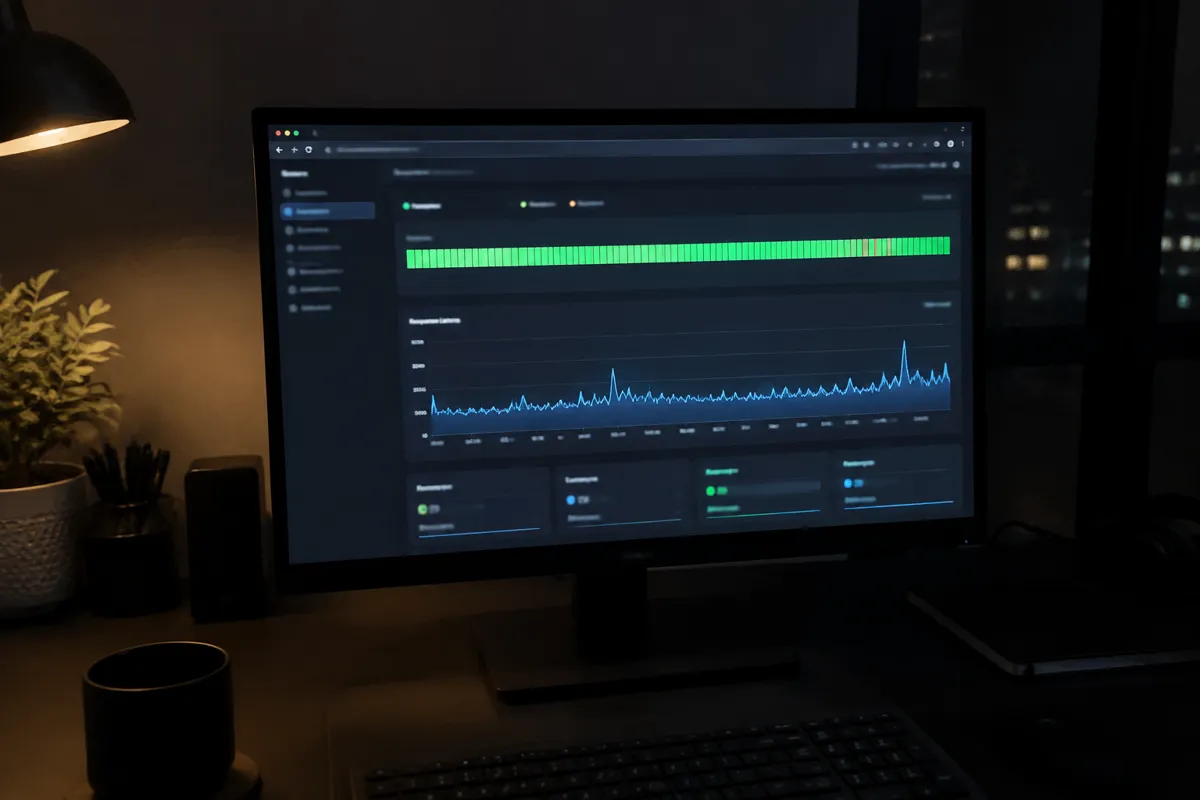
The practice of continuously checking whether a server is responding, used to measure real-world uptime.
Data center redundancy
Infrastructure design choices that reduce the chance of downtime in the first place.

A Concrete Example
An online retailer’s hosting provider guarantees 99.9% uptime in its SLA. Over the course of a year, that guarantee technically allows for around 8.76 hours of downtime without breaching the agreement. Say the retailer’s site goes down for two hours during a hardware failure in March, and then again for one hour during a network issue in September. The provider is still within its stated guarantee for the year, even though the retailer experienced real, noticeable outages. If downtime exceeds that threshold, many providers offer service credits as compensation, per the terms of the SLA.
Common Misconception
A common misconception is assuming a provider advertising “99.9% uptime” means outages basically never happen. As the table above shows, even a strong 99.9% guarantee still permits close to nine hours of downtime across a year. That’s enough for a business to notice real impact if that downtime lands during peak sales hours. Another frequent mix-up is treating advertised uptime figures as guaranteed facts about future performance, rather than a contractual target that may or may not be met. The only way to verify real uptime is independent monitoring over time, not the number printed on a pricing page.
FAQ
What uptime percentage should I look for in a hosting provider? Most established, reputable providers advertise 99.9% or higher. Anything meaningfully below that suggests weaker infrastructure or a lack of investment in redundancy.
Does a missed uptime guarantee get me a refund? Typically not a full refund. Most SLAs offer service credits (partial account credit) rather than cash refunds, and usually only after downtime is reported and verified against the provider’s own monitoring.
How is uptime actually measured? Providers and independent monitoring services use automated tools that repeatedly send requests to a server at short intervals. These tools log whether and how quickly it responds, then calculate the percentage of successful checks over time.
Is 100% uptime realistic? Practically no. Even world-class infrastructure occasionally needs maintenance, faces unexpected hardware failures, or experiences network issues outside a provider’s direct control. That’s why guarantees are set just under 100% rather than at it.